
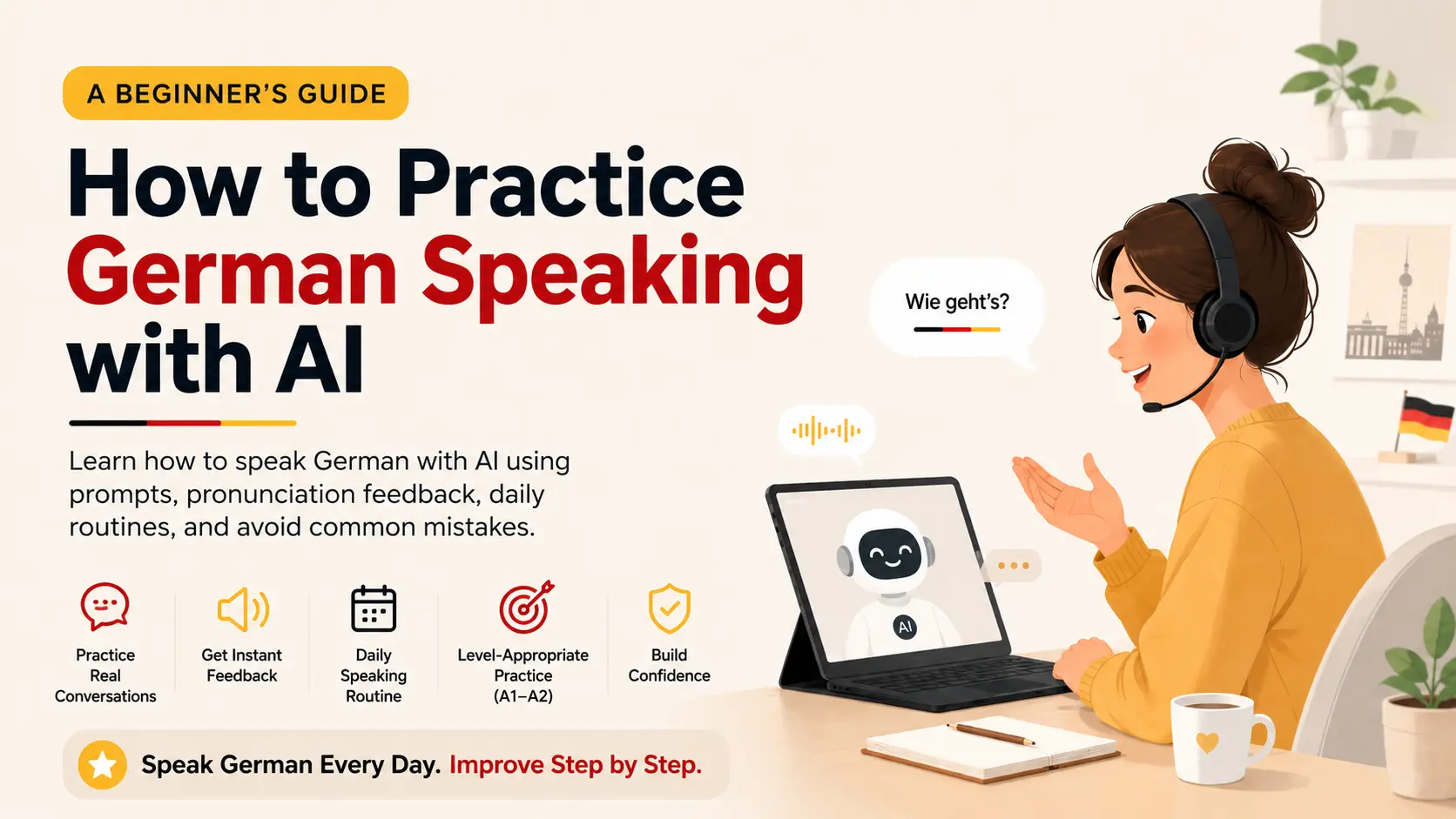
If you are learning German as a beginner, speaking is usually the skill that feels most difficult to practice alone.
You can review vocabulary by yourself. You can do grammar exercises by yourself. You can read short German texts and listen to beginner audio. But speaking needs a response. It needs correction. It needs repetition. That is why many learners search for things like "how to practice German speaking alone," "AI German speaking practice," "German conversation practice app," and "best app to speak German."
AI can help with this, but only if you use it the right way.
For beginners, the goal is not to have random open-ended conversations for 30 minutes. The goal is to practice small, level-appropriate speaking tasks until basic German sentences become easier to produce.
This guide shows you how to use AI for German speaking practice at A1 and A2 level, what to say, what to avoid, and how to turn speaking practice into real progress.
Quick Answer: How Should Beginners Practice German Speaking with AI?
The best way to practice German speaking with AI is to use short, structured conversations based on your level.
Start with simple A1 topics:
- Introducing yourself
- Ordering food
- Asking for directions
- Talking about your family
- Booking an appointment
- Describing your day
- Saying what you like and do not like
Then ask the AI to correct three things:
- Grammar
- Word order
- Pronunciation or fluency
Do not try to speak perfectly. Try to speak often.
For a beginner, 10 minutes of focused German speaking practice every day is more useful than one long, stressful conversation once per week.
Why German Speaking Is Hard for Beginners
German speaking is not hard because learners are lazy. It is hard because speaking combines several skills at once.
When you speak German, you need to:
- Remember the right vocabulary
- Choose the right verb form
- Put the verb in the correct position
- Use the correct article or case
- Pronounce the sentence clearly
- Understand the answer quickly enough to respond
That is a lot to do in real time.
This is why many learners feel that they "know" German when doing exercises, but freeze when they need to speak. Recognition is easier than production. Speaking forces you to produce German without hiding behind multiple-choice answers.
AI speaking practice is useful because it lets you repeat this production step without waiting for a teacher, tutor, or language partner.
What AI German Speaking Practice Is Good For
AI is especially helpful for beginner German speaking practice when it is used for repetition and feedback.
It can help you:
- Practice basic German conversations
- Repeat common speaking scenarios
- Get instant corrections
- Build confidence before speaking to real people
- Turn passive vocabulary into active vocabulary
- Notice repeated grammar mistakes
- Practice when no tutor or partner is available
This matters because the official CEFR self-assessment grid separates speaking into spoken interaction and spoken production. In other words, German learners need both conversation and the ability to produce longer answers.
For A1 and A2 learners, AI can support both.
What AI German Speaking Practice Is Not Good For
AI is not a complete replacement for real human conversation.
It may miss nuance. It may accept awkward German. It may correct something too strictly or too loosely. It may also let you stay inside safe beginner topics for too long.
That does not make it useless. It means you should use it as a practice tool, not as your only source of truth.
For serious learners, the best setup is:
- AI speaking practice for daily repetition
- Grammar practice to understand sentence structure
- Listening practice to understand native speech
- Writing practice to slow down and fix mistakes
- Reading practice to absorb natural patterns
- Real conversation when possible
That is why Langey is built around all six German learning skills: vocabulary, grammar, speaking, writing, reading, and listening.
The Best Beginner Routine for AI German Speaking Practice
Use this 10-minute routine if you are at A1 or early A2.
| Time | Task | Example |
|---|---|---|
| 2 minutes | Warm up | Say 5 simple sentences about yourself |
| 4 minutes | Roleplay | Order coffee, introduce yourself, ask for directions |
| 2 minutes | Correction | Ask for your top 3 mistakes |
| 2 minutes | Repeat | Say the corrected version again |
The final repeat is important. Many learners read corrections, nod, and move on. That does not build speaking ability. You need to say the corrected sentence out loud.
Beginner AI Prompts for German Speaking Practice
If you are using an AI tool that accepts prompts, start with very specific instructions.
Prompt 1: A1 Conversation Practice
Use this when you are just starting.
Act as a friendly German tutor. I am A1 level. Ask me one simple question at a time in German. Use short sentences. After each answer, correct my grammar and word order in English, then ask the next question.
Good topics:
- Name
- Age
- Country
- Job
- Hobbies
- Family
- Daily routine
Prompt 2: German Speaking Correction
Use this when you want feedback.
Correct my German answer. Focus only on grammar, word order, and natural phrasing. Show me:
1. My original sentence
2. The corrected sentence
3. A short explanation
4. One more example sentence
This keeps correction practical. You do not need a full grammar lecture after every sentence.
Prompt 3: Roleplay for Real Life
Use this for practical speaking.
Roleplay a simple A1 German conversation with me. The situation is: I am ordering food at a cafe. You are the waiter. Keep your German slow and simple. Correct me after every 2 replies.
Useful roleplay topics:
- At a cafe
- At the supermarket
- At the doctor
- At a hotel
- Buying a train ticket
- Meeting a new person
- Talking to a neighbor
Prompt 4: A2 Speaking Expansion
Use this once A1 feels too easy.
I am A2 German level. Ask me questions about my weekend, my plans, and my opinions. Encourage me to answer in 3 to 5 sentences. Correct grammar, verb position, and missing connectors like weil, dass, wenn, and aber.
A2 speaking needs longer answers. You are no longer only saying "Ich komme aus..." or "Ich wohne in..." You are learning to connect ideas.
What Should Beginners Say First?
If speaking feels scary, start with sentence frames.
Use these every day:
| English | German frame |
|---|---|
| My name is... | Ich heisse... |
| I come from... | Ich komme aus... |
| I live in... | Ich wohne in... |
| I work as... | Ich arbeite als... |
| I like... | Ich mag... |
| I would like... | Ich moechte... |
| I have a question. | Ich habe eine Frage. |
| Can you repeat that? | Koennen Sie das wiederholen? |
| I do not understand. | Ich verstehe das nicht. |
These phrases are not glamorous, but they are useful. Speaking starts with reusable chunks.
The Biggest Mistake: Practicing Conversation Without Grammar
Many learners want to "just speak." That sounds natural, but German punishes weak structure quickly.
For example:
- Ich gehe heute ins Kino.
- Heute gehe ich ins Kino.
- Weil ich heute ins Kino gehe.
The meaning is simple, but the verb position changes. If you never practice grammar, your speaking will stay shaky.
This is why AI speaking practice works best when paired with German grammar exercises. You need both.
Use speaking to activate grammar. Use grammar to improve speaking.
How Langey Helps with AI German Speaking Practice
Langey is built for serious German learners who want a structured path from A1 to B1.
Instead of practicing speaking in isolation, Langey connects speaking with the rest of your German learning:
- Vocabulary so you have words to use
- Grammar so your sentences hold together
- Speaking so you can produce German out loud
- Writing so you can slow down and fix mistakes
- Reading so you see correct German in context
- Listening so you can understand replies
This is important because real speaking is not just pronunciation. It is the result of all your German skills working together.
If your goal is to practice German speaking with AI and actually improve, you need a system that does more than open a chat window.
Is AI Enough to Learn German Speaking?
AI can help you build confidence and repetition, but it is not enough by itself.
You still need:
- Vocabulary practice
- Grammar review
- Listening exposure
- Reading input
- Writing correction
- Real-world speaking when possible
Think of AI as a speaking gym. It gives you repetitions. It helps you get less nervous. It shows you mistakes. But you still need a complete training plan.
For A1 and A2 learners, AI is best used daily in small sessions.
For B1 learners, AI becomes useful for longer conversations, opinions, storytelling, and exam-style speaking tasks.
FAQ: AI German Speaking Practice
Can I practice German speaking alone?
Yes. You can practice German speaking alone with AI roleplays, speech recognition, shadowing, and self-recording. The key is to speak out loud, get corrections, and repeat corrected sentences.
What is the best way to practice German speaking as a beginner?
Start with short A1 conversations and practical roleplays. Introduce yourself, order food, ask simple questions, and describe your day. Keep sessions short and repeat the same scenarios until they feel easy.
Can AI correct my German pronunciation?
Some AI tools and language apps offer pronunciation or speech feedback. This can help, but you should also listen to native German audio and repeat full phrases, not just individual words.
How often should I practice German speaking?
Beginners should aim for 5 to 10 minutes daily. Speaking improves through frequency. Short daily practice is usually better than one long weekly session.
Is AI German speaking practice good for Goethe A1 or B1?
It can help, especially for speaking confidence and exam-style answers. But the Goethe-Institut exams test multiple skills, and Goethe offers official exams and practice materials from A1 to C2, so speaking practice should be part of a broader plan.
Sources and Helpful Resources
- Council of Europe CEFR self-assessment grid
- Goethe-Institut German exams A1-C2
- Langey German learning platform
- Langey German learning roadmap
Final Advice
If you are a beginner, do not wait until you "know enough German" to speak.
Start speaking now, but keep it simple. Use AI for short roleplays, ask for corrections, repeat the corrected version, and connect your speaking practice to vocabulary, grammar, reading, writing, and listening.
That is how AI German speaking practice turns from a novelty into real progress.