
Reaching B1 in German within a year is absolutely achievable — but it requires a structured plan, not just downloading an app and hoping for the best. Here's the roadmap we follow at Langey, based on what actually works.
What B1 Actually Means
B1 is the third level on the CEFR scale. At B1, you can:
- Handle most situations that come up while travelling in a German-speaking country
- Describe experiences, events, and explain your opinions on familiar topics
- Understand the main points of clear standard speech on familiar matters
It's the level that makes you genuinely functional in everyday German. Not fluent — but real.
The 12-Month Breakdown
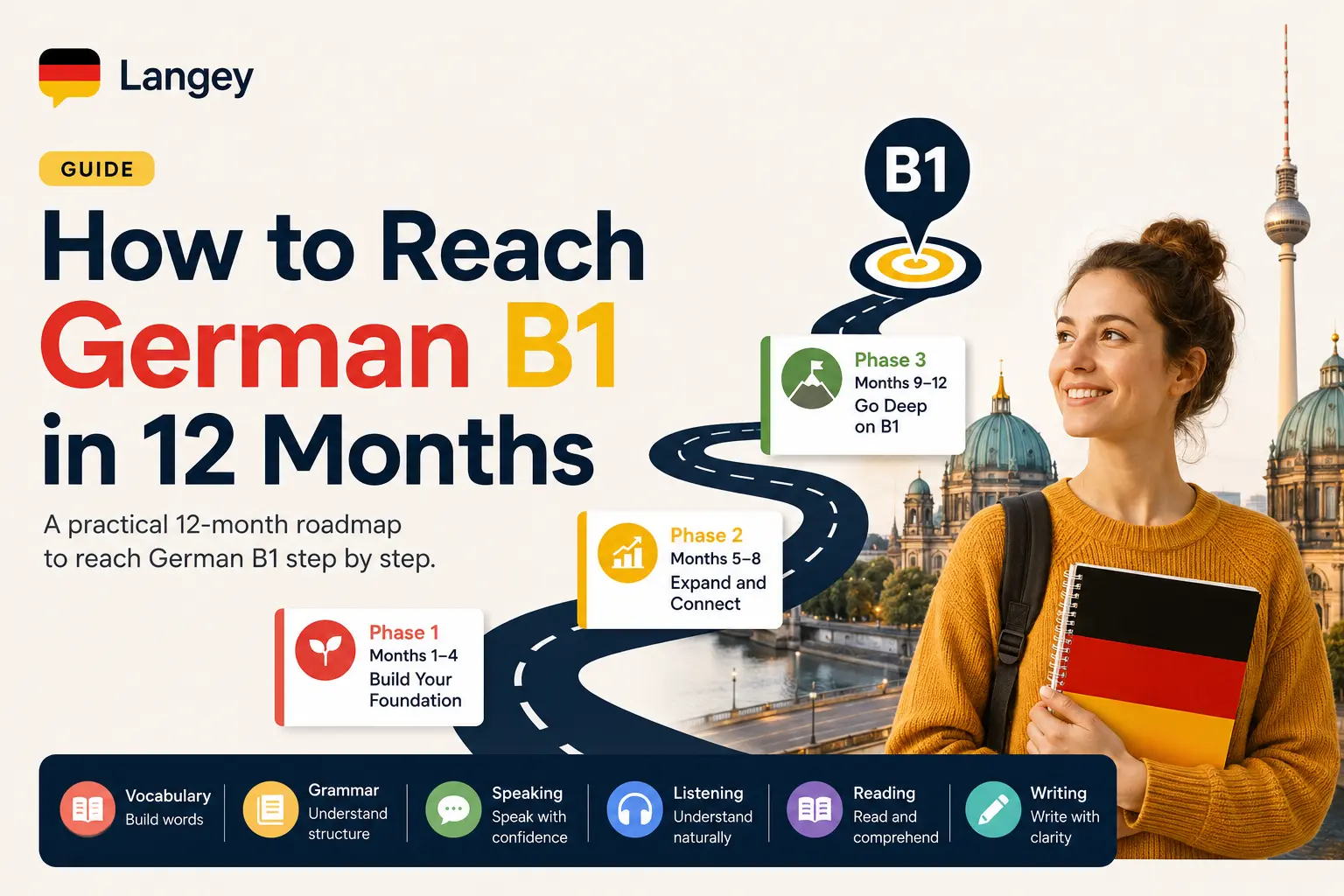
Think of the year in three phases of roughly four months each.
Phase 1 (Months 1–4): Build Your Foundation
This is the A1 phase. Your goals here are simple: learn the alphabet and pronunciation, build a core vocabulary of ~500 words, and get comfortable with basic present tense.
Daily routine:
- 20 minutes of vocabulary flashcards
- 10 minutes of grammar exercises
- 5 minutes of listening to simple German audio
Don't skip vocabulary. It's the unsexy work that makes everything else possible.
Phase 2 (Months 5–8): Expand and Connect
You're now at A2. This phase is about connecting the dots — learning to tell stories in the past, talk about the future, and string sentences together.
What to focus on:
- Past tense (Perfekt and Präteritum)
- Modal verbs (können, müssen, wollen, dürfen, sollen, mögen)
- Connecting words (weil, dass, obwohl, wenn)
This is also the phase where you should start speaking. Even if it feels uncomfortable, speaking practice is irreplaceable.
Phase 3 (Months 9–12): Go Deep on B1
By month 9 you have a real base. Now it's about volume and complexity. You'll encounter:
- Subordinate clauses and word order rules
- The Konjunktiv II (subjunctive mood)
- Longer reading and listening passages
- Writing structured responses
The biggest mistake learners make at this stage is avoiding their weak spots. If writing is hard, write more. If listening feels slow, listen every day.
The Six Skills — and Why You Need All of Them
Many learners grind vocabulary and grammar but ignore speaking and writing. This is a mistake.
| Skill | Why It Matters |
|---|---|
| Vocabulary | Everything else builds on this |
| Grammar | The glue that holds sentences together |
| Speaking | Turns passive knowledge into active use |
| Listening | Where most real-world German happens |
| Reading | Exposes you to natural language patterns |
| Writing | Forces you to produce correct German |
Langey is built around all six skills for exactly this reason — they compound each other.
How Much Time Does It Actually Take?
A realistic estimate for reaching B1 from zero is 500–600 hours of active study. Spread over a year, that's roughly:
- 1.5 hours per day, every day, or
- 2 hours on weekdays + a longer session on weekends
You don't need to be perfect with this. A missed day won't break you. But consistency over months is what separates those who reach B1 from those who plateau at A2.
Common Mistakes to Avoid
Mistake 1: Studying too many things at once. Focus. Don't juggle five different apps, two textbooks, and three YouTube channels. Pick a system and go deep.
Mistake 2: Passive studying only. Watching German TV counts as input, but it doesn't replace actively producing German. Use it as a supplement.
Mistake 3: Avoiding grammar. Grammar is the framework your vocabulary hangs on. You don't need to love it — but you do need to understand it.
Mistake 4: Not tracking progress. Set a checkpoint every four weeks. Test yourself. Seeing growth is one of the strongest motivators to keep going.
You Can Do This
Learning German to B1 in a year is a real, reachable goal. Thousands of learners have done it. The difference between those who do and those who don't isn't talent — it's having a plan and sticking to it.
Start today. Even 20 minutes counts.