
You buy a textbook. You join a class. You download an app. You feel motivated. You study for two weeks. And then... you hit a wall.
You're not sure if you're making progress. You don't know what to focus on next. You're spending time on things that don't seem to move the needle. You're confused about whether you're weak in speaking, listening, or grammar. And slowly, you stop.
This isn't a failure of motivation. This is a failure of direction.
The Stats Are Brutal
Research on language learning shows:
- 70% of learners quit within three months
- Only 15% reach conversational fluency from self-study
- The #1 reason for quitting: "Not sure if I'm making progress"
Notice that last one. It's not "too hard." It's not "no time." It's uncertainty. Learners quit because they can't see the path.
Why Traditional Methods Fail
The Textbook Problem: You work through a book chapter by chapter. But you don't know:
- Are you actually ready for the next chapter?
- Which skill is holding you back?
- How much more do you need to do before you can hold a real conversation?
A textbook is linear. Your learning isn't.
The Classroom Problem: A teacher moves through material at a fixed pace. They teach 30 students at once. Some are ahead. Some are behind. No one gets personalized attention.
The reality: A classroom works great if you're exactly average. If you're weak in listening but strong in grammar, the teacher can't slow down just for you. If you're ahead, you're bored.
The teacher can't diagnose where each student is weak and give targeted help. They teach to the middle and hope it works.
The App Problem: An app is even worse. It shows you a green streak if you keep your daily habit. But it doesn't tell you:
- What level are you actually at?
- What are your specific weak points?
- How much longer until you reach your goal?
- What should you study next to get there fastest?
You're swiping through lessons, but you have no idea if you're moving toward fluency or just going in circles.
What A Real Roadmap Does
A roadmap is different. It answers the questions learners actually need answered:
1. Where am I right now? Not in vague terms like "intermediate," but specifically:
- Can I handle past tense? (No)
- Can I understand native speech at normal speed? (No)
- Can I write a short paragraph without errors? (Mostly)
2. What are my specific weak points? Not "I'm bad at German overall," but:
- My listening comprehension is 60% — here's what to focus on
- My grammar knowledge is 75% — these are the gaps
- My speaking is 40% — we need to drill this
3. What's the exact path to my goal? If you want to reach B1:
- You need to master X grammar concepts (here they are)
- You need Y hours of listening practice (here's what you're at)
- You need to practice speaking Z times per week (here's your schedule)
4. How do I know I'm progressing? Real metrics:
- Three weeks ago, you could handle A1 conversations. Now you handle A2.
- Your listening comprehension was 55%. Now it's 68%.
- You couldn't write past tense. Now you can.
Progress you can see.
The Personalization Problem
Here's what most learners don't realize: Everyone's weak spots are different.
- German speaker #1 struggles with speaking but has solid grammar
- German speaker #2 can speak but can't understand native listening
- German speaker #3 knows vocabulary but freezes on case agreement
A generic textbook or app gives the same content to everyone. But you don't need the same help as everyone else.
A real roadmap adapts to your specific gaps. You don't waste time on things you already know. You spend extra time on the things that actually hold you back.
This is why even well-designed apps fail. They treat all learners as interchangeable. But you're not.
What Learners Actually Need
The research is clear. Learners who succeed have:
- A clear end goal (not vague, but specific: "B1 in 12 months")
- A current assessment (where are you actually at right now?)
- A step-by-step path (what to study, in what order)
- Visible progress metrics (proof that you're getting closer)
- Targeted feedback (you're weak here, focus on this)
Without all five, learners quit. They don't know if they're getting closer or stuck.
The Classroom Comparison
Here's the paradox: A good classroom provides all five. A teacher diagnoses what you can and can't do. They tell you what to work on. They show you progress (a test score, a conversation you can now handle). They give feedback specific to you.
The problem is classrooms are expensive, inconvenient, and can't truly personalize for 20+ students at once.
But what if you could have the structure and feedback of a classroom with the convenience and personalization of self-study?
That's what a real roadmap does.
How to Know If Your Learning Method Has a Real Roadmap
Ask yourself:
- Can I see exactly where I am right now (not "intermediate," but specific skills)?
- Do I know which skills to focus on based on my specific weaknesses?
- Is there a clear path from where I am to my end goal?
- Can I see progress over time (not just a streak, but actual skill growth)?
- Does the platform diagnose my weak spots and tell me what to study?
If any of these are "no," you don't have a roadmap. You have a collection of lessons.
The Real Reason Learners Quit
People don't quit because German is hard. They quit because they can't see that they're getting closer.
They quit because they're uncertain if they're spending their time on the right things.
They quit because every method treats them like everyone else, even though their weak spots are unique.
They quit because there's no finish line — just endless lessons.
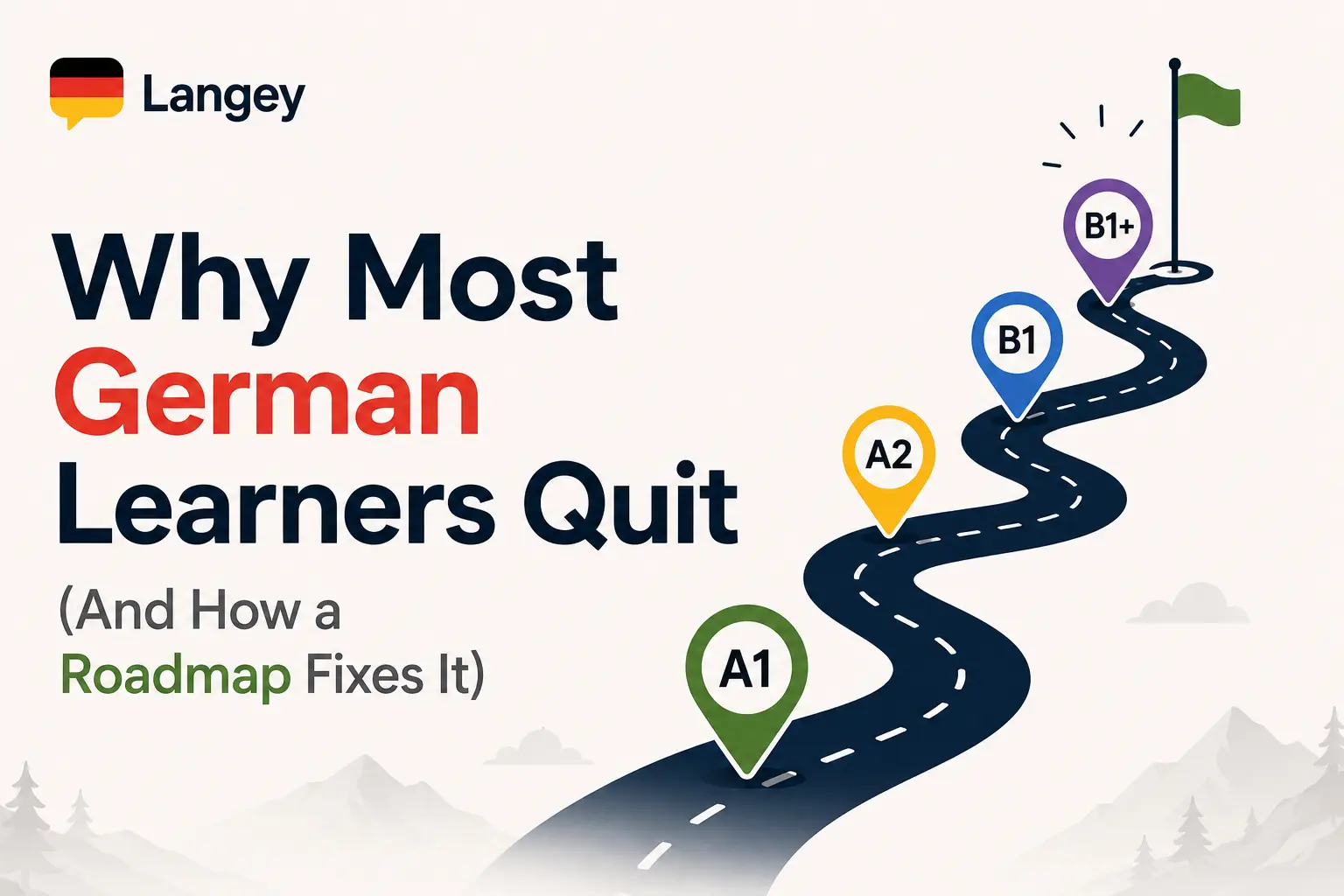
A roadmap changes all of that. It gives you a target. It shows you the path. It tells you which fork in the road matters for you. And it proves every day that you're getting closer.
That's not motivation. That's clarity.
And clarity is what actually moves people from "trying to learn German" to "speaking German."